
A launch monitor gives two sets of numbers on every shot: ball data, what the ball did as it left the club, and club data, what the club was doing at impact. This guide explains each number in plain words, using the makers' own definitions from Trackman, Foresight, FlightScope, Garmin and others. It covers which way left and right are counted, what tour players and everyday golfers average, and which numbers a launch monitor actually measures and which it works out. Jay Lasco, host of Golf Simulator Videos, has tested launch monitors side by side since 2020, and his findings on spin and spin axis indoors are in here too.
Looking for a launch monitor that shows these numbers? GSV5OFF takes 5% off a first order at Shop Indoor Golf, launch monitors included, and every code is on the golf simulator discount codes page.
Launch monitors GSV has tested
- Garmin Approach R105% off at Shop Indoor Golf with code GSV5OFF.First-time buyers only, one use. Not valid on a standalone Trackman, the Square Golf launch monitor or the ProTee VX.
- FlightScope Mevo Gen25% off at FlightScope with code GSVMEVO.
- Square Golf Home Edition5% off at Square Golf with code GSVSQUARE.
- Uneekor EYE XO25% off at Shop Indoor Golf with code GSV5OFF, first-time buyers.
Will it fit? See each in your room in the free GSV Sim Builder, in 3D: Garmin R10, Mevo Gen2, Square Golf HE, EYE XO2.
Buying through GSV's links and codes helps support the channel: GSV earns a small commission at no extra cost to you, and you still get every saving available.
Find the launch monitor for your room The best golf launch monitors
- 1.50The smash factor Trackman says a driver should be near
- -2 to 2Spin axis Trackman counts as a straight shot
- 45+ degLanding angle Trackman recommends for approach shots
On this page: the short answer, ball data, club data, plus and minus: left and right, the same number by other names, tour and amateur averages, measured or calculated, what Jay found indoors, why a ball curves, the numbers to watch at home, which launch monitor shows which numbers, free consultation and questions.
The short answer
- Ball speed, launch angle and spin decide how far the ball goes. Every launch monitor starts with these.
- Launch direction and spin axis decide where it starts and how it curves.
- Carry, total, apex and landing angle are the flight that follows. Most launch monitors calculate them from the launch numbers.
- Club speed, attack angle, club path, face angle and dynamic loft explain why the ball did what it did.
- Smash factor is ball speed divided by club speed: how well the ball was struck.
- Indoors, radar units need help to read spin: Titleist RCT balls or a stick-on dot, by their makers. Most camera units read spin from the ball itself.
Ball data
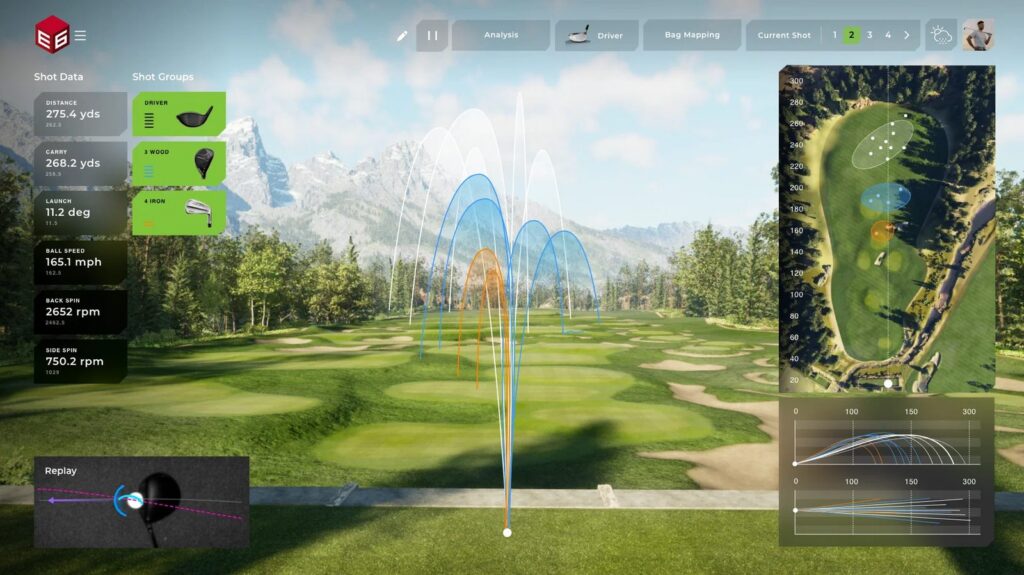
| Number | What it means | Good to know |
|---|---|---|
| Ball speed (mph) | How fast the ball leaves the club face, measured just after impact. | The biggest single piece of distance. |
| Launch angle (deg) | The vertical angle the ball takes off at, against the horizon. | Usually a little less than dynamic loft, by Trackman. |
| Launch direction (deg) | The horizontal angle the ball starts on, against the target line. | The ball starts much closer to where the face points than to the path. |
| Spin rate (rpm) | How fast the ball turns, in revolutions per minute. | More loft and more club speed both add spin, by Trackman. |
| Backspin and sidespin (rpm) | Parts of the total spin: backspin gives lift and height, sidespin gives curve. | Foresight and Bushnell show them. Trackman shows spin rate and spin axis instead. |
| Spin axis (deg) | The tilt of the line the ball spins around. | Tilted left curves left, tilted right curves right. Between -2 and 2 is straight, by Trackman. |
| Carry (yd) | How far the ball flies until it comes back to the height it was hit from. | Know your average carry for each club, not your longest. |
| Total (yd) | Carry plus bounce and roll, to where the ball stops. | Calculated, on flat ground of normal firmness, by Trackman. |
| Roll or run (yd) | The distance from where the ball lands to where it stops. | Steeper landings roll less. |
| Apex or peak height (ft or yd) | The highest point of the flight, above where the ball was hit. | A driver and a pitching wedge peak within about 3 yd of each other, by Trackman. |
| Landing or descent angle (deg) | How steeply the ball comes down. | Over 45 deg on approach shots for stopping power, by Trackman. |
| Offline or side (yd) | How far right or left of the target line the ball lands or stops. | Right is plus, left is minus, on Trackman. |
| Hang time (sec) | How long the ball is in the air until it lands. | Shown by Trackman and FlightScope. |
Definitions from Trackman's data parameter definitions (updated November 27, 2025) and its parameter articles, Foresight's ball launch data help page (December 8, 2025) and FlightScope's data page, read October 20, 2026.
Club data
| Number | What it means | Good to know |
|---|---|---|
| Club speed (mph) | How fast the club head moves just before it meets the ball. | The engine of ball speed. |
| Smash factor | Ball speed divided by club speed. Foresight calls it efficiency. | Near 1.50 with a driver and near 1.25 with a pitching wedge, by Trackman. |
| Attack angle (deg) | Whether the club head is moving up or down at impact. | Minus is down, plus is up. Shots off the ground should be minus, by Trackman. |
| Club path (deg) | Whether the club head is moving right or left of the target at impact. | Plus is right of target (in to out for a right-hander), minus is left. |
| Face angle (deg) | Where the club face points at impact, against the target line. | The ball launches very close to the face angle, by Trackman. |
| Face to path (deg) | Face angle minus club path. | With a centered strike the ball curves toward the face and away from the path. |
| Dynamic loft (deg) | The loft on the face at impact. Foresight calls it impact loft. | Usually a little more than the launch angle, by Trackman. |
| Spin loft (deg) | The angle between where the club is moving and where the face points. | About dynamic loft minus attack angle. More spin loft, more spin. |
| Lie (deg) | The tilt of the club at impact, toe up or toe down. | Trackman measures the shaft; Foresight measures the face, with minus as toe down. |
| Impact location | Where on the face the ball was struck, from the center. | Heel strikes spin more and curve right, toe strikes the opposite, for a right-hander, by Trackman. |
| Low point | Where the bottom of the swing arc is, before or after the ball. | With a minus attack angle the low point is after the ball. |
| Closure rate | How fast the face is closing through impact. | Shown by Foresight. |
Definitions from Trackman's parameter articles and Foresight's measurement page, read October 20, 2026.
Plus and minus: left and right
Trackman spells out its signs:
- Launch direction, club path, face angle, offline: plus is right of the target, minus is left.
- Spin axis: plus curves right, minus curves left. For a right-hander Trackman labels a big minus a hook, a small minus a draw, a small plus a fade and a big plus a slice.
- Face to path: plus means the face points right of the path, whichever hand you play.
- Attack angle: minus is hitting down, plus is hitting up.
Foresight describes direction in words, such as inside-out or outside-in for path, rather than with signs. When two launch monitors seem to disagree on direction, check which way each one counts first.
The same number by other names
- Launch direction = azimuth = side angle = horizontal launch angle (HLA).
- Landing angle = descent angle = vertical descent.
- Apex = height = peak height.
- Offline = side = carry side = lateral landing = carry deviation.
- Roll = run.
- Smash factor = efficiency.
- Dynamic loft = impact loft.
- Hang time = flight time.
Tour and amateur averages
Trackman's PGA Tour averages, from the 2023 season, published in 2024:
| Number | Driver | 6 iron |
|---|---|---|
| Club speed | 115 mph | 94 mph |
| Smash factor | 1.49 | 1.39 |
| Launch angle | 10.4 deg | 14.0 deg |
| Spin rate | 2,545 rpm | 6,204 rpm |
| Attack angle | -0.9 deg | -3.7 deg |
| Dynamic loft | 12.8 deg | 20.2 deg |
Trackman's tour driver averages 171 mph of ball speed and 282 yd of carry. On the LPGA Tour, Trackman gives a driver at 96 mph club speed, 143 mph ball speed, 2,506 rpm and 223 yd carry, with a plus 2.8 deg attack angle: hitting up on it.
Trackman's driver averages for male amateurs, from its Combine:
| Handicap | Club and ball speed | Launch, spin and attack angle |
|---|---|---|
| Scratch | 110 and 161 mph | 11.2 deg, 2,896 rpm, -0.9 deg |
| 5 | 101 and 147 mph | 11.2 deg, 2,987 rpm, -1.1 deg |
| 10 | 95 and 138 mph | 11.9 deg, 3,192 rpm, -1.2 deg |
| Average golfer (14.5) | 94 and 133 mph | 12.6 deg, 3,275 rpm, -1.8 deg |
| Bogey | 92 and 131 mph | 12.1 deg, 3,127 rpm, -2.1 deg |
Trackman's pages, read October 20, 2026. Trackman puts the average golfer's driver smash factor at 1.44, against 1.49 on tour.
Measured or calculated
No launch monitor measures everything. Some numbers are read straight off the ball or the club, and others are worked out from them. What the makers say:
- The flight: indoors the screen stops the ball, so carry, total, apex and landing angle are worked out from the launch numbers. Foresight lists them as calculated on its cameras, and Trackman calculates total even outdoors, on flat ground of normal firmness.
- Radar indoors (Trackman 4, Garmin R10): the radar sees only a short flight, so spin axis is calculated rather than measured: from the club data by Trackman, and from launch direction and club path by Garmin. Total spin is measured with Titleist RCT balls; Titleist says without them spin is estimated indoors.
- FlightScope: indoors, aluminum stickers on the ball, or RCT balls, for spin. The Mevo Gen 2 adds a camera to its radar, and needs at least 8 ft of ball flight, by FlightScope.
- Camera units (Foresight, Garmin R50, Uneekor, Bushnell Launch Pro): read spin and spin axis from the ball itself, with no marked balls. Garmin says the R50 does this indoors and out, Bushnell labels its ball data measured, and Foresight says its cameras measure club data rather than calculate it.
- Square Golf: a camera unit beside the ball that uses Square Golf's patterned balls for its full data, and a club marker for club data.
- Rapsodo MLM2PRO and MLM2XPRO: Rapsodo lists spin and spin axis as measured, with its RPT balls needed for spin.
- Club data on camera units often needs a sticker: Uneekor's EYE XO page says its club data requires club stickers, and the Garmin R50 uses an included sticker. The Trackman iO and ProTee VX read the club with none.
Why two launch monitors can disagree on path. Trackman says it measures club speed, attack angle and path at the club head's geometric center, close to its center of gravity, while camera units almost always measure them at the center of the face. With a driver, Trackman puts the difference at about 3 deg in path and 1 deg in attack angle. Compare path and attack angle between a radar unit and a camera unit with that in mind.
What Jay found indoors
- Garmin R10, 2022: with Titleist RCT balls it read total spin but not spin axis indoors. Against an Uneekor, RCT spin stayed mostly within 100 to 200 rpm, while a stick-on metal dot had some large misses. More in the Garmin R10 review.
- Garmin R10 on chips: launch angle and direction read fine, but on short shots there is not enough movement for the radar to give attack angle, path or face, in Jay's 2026 testing.
- Rapsodo MLM2PRO beside a Foresight GCQuad, 2023: carry and spin axis were close, within a few yards and fractions of a degree on most drives. See the MLM2PRO review.
- SkyTrak: SkyTrak told Jay that club path and face angle are calculated, and most confident on wedges. See SkyTrak vs Garmin R10.
- Golf balls: which ball each launch monitor needs indoors is in golf balls for a simulator.
Why a ball curves
The ball starts close to where the face points and curves away from the path. Trackman calls the tilt that sets the curve the D-plane tilt, "the expected spin axis disregarding any gear effect from off-center strike". When face to path is zero, the tilt is zero and the ball does not curve. A strike off the center of the face adds gear effect on top: heel strikes curve right and toe strikes left, for a right-hander, by Trackman.
That is also why a radar unit indoors can miss a curve. It works spin axis out from the club data, so a ball curved by an off-center strike can read straighter than it flew.
The numbers to watch at home
- Carry for each club: the average, not the best. Bag mapping in most simulator software builds the chart for you.
- Smash factor: how centered the strike is. Low smash with good club speed points to off-center contact.
- Driver launch and spin: the pair that decides driver distance once speed is set.
- Attack angle: minus with irons and wedges off the turf.
- Face to path: the curve. Plus curves right, minus curves left.
- Landing angle: how well an approach holds the green.
Which launch monitor shows which numbers
Every launch monitor shows ball speed, launch and spin. Club data is where they differ: some read it, some calculate it, some need stickers or a paid plan, and some show only club speed. Each launch monitor's figures, price and room are in the best golf launch monitors. The ones under $1,000 are in the best launch monitors under $1,000, and the ones with no yearly fee for their data are in launch monitors with no subscription. The launch monitor finder sorts them by budget and room.
The GSV Sim Builder shows each launch monitor's hitting zone in your room.
Build the rest of your simulator
- Golf simulator enclosures and screens$250 off at Shop Indoor Golf with code GSV250.SIG8, SIG10 and SIG12 enclosures and studios, DIY and commercial enclosures, G-TRAK screens, SIGPRO flooring and complete simulator packages.
- Golf hitting mats$20 off at Shop Indoor Golf with code GSVMAT. On a first order over $400, GSV5OFF takes more: 5% off.SIGPRO Softy, Super Softy, Softy Lite and Commercial Teeline mats.
- Golf simulator projectors5% off at Shop Indoor Golf with code GSV5OFF.First-time buyers only, one use. Not valid on a standalone Trackman, the Square Golf launch monitor or the ProTee VX.
- Complete golf simulator packages$250 off at Shop Indoor Golf with code GSV250. On a first order over $5,000, GSV5OFF takes more: 5% off.
Free consultation with GSV's partner builders
Not sure which launch monitor reads the numbers you care about? Jay works with official partners: master builders he hand-picked, who get on a call quickly and make sure the launch monitor, the room and the software fit before you buy. They offer package deals on the whole build, DIY packages, full installation, and more. The consultation is free.
Launch monitor numbers: questions
What is smash factor on a launch monitor?
Ball speed divided by club speed: how much of the club's speed went into the ball. Foresight calls it efficiency. Trackman says a driver should be near 1.50 and a pitching wedge near 1.25.
What is a good smash factor with a driver?
Near 1.50, by Trackman. Its PGA Tour average for 2023 was 1.49, and its average male amateur, a 14.5 handicap, is at 1.44.
What is spin axis?
The tilt of the line the ball spins around, which sets the curve. On Trackman, plus curves right and minus curves left, and between -2 and 2 counts as a straight shot.
Should attack angle be negative?
With shots off the ground, yes: Trackman says they should have a negative attack angle, hitting down. With a driver, Trackman's averages are -0.9 deg on the PGA Tour, -1.8 deg for its average male amateur and plus 2.8 deg on the LPGA Tour.
What does face to path mean?
Face angle minus club path. With a centered strike the ball curves toward the face and away from the path: a plus face to path curves right and a minus one curves left, whichever hand you play, by Trackman.
What is the difference between carry and total?
Carry is how far the ball flies until it comes back to the height it was hit from. Total adds the bounce and roll to where it stops, and Trackman calculates it for flat ground of normal firmness.
What is the average driver swing speed?
Trackman's average male amateur, a 14.5 handicap, swings a driver at 94 mph for 133 mph of ball speed. The PGA Tour averaged 115 mph and 171 mph in 2023.
Do launch monitors measure spin indoors?
Camera units read spin from the ball. Radar units see only a short flight indoors: the Garmin R10 measures total spin with Titleist RCT balls and calculates spin axis, and Titleist says that without RCT balls spin is estimated indoors on Trackman.
Why do two launch monitors show a different club path?
They may measure at different points. Trackman says it measures path and attack angle at the club head's geometric center, close to its center of gravity, while camera units almost always measure at the center of the face, about 3 deg of path apart with a driver.
Is there free help choosing a launch monitor?
Yes. GSV's partner builders, master builders Jay hand-picked, offer a free consultation: they check that the launch monitor, the room and the software fit before you buy, and offer package deals, DIY packages and full installation.
Build the rest of your sim
- Enclosure and screen$250 off at Shop Indoor GolfShop
- Carl's Place enclosure5% off, code sent by emailShopGet the code
- Hitting mat$20 off at Shop Indoor Golf. GSV5OFF is more on a first order over $400Shop
- Projector5% off at Shop Indoor Golf. First-time buyersShop
- Simulator computerSurfThing: $100 off applied automatically, no codeShop
- TouchscreenGSV code for TouchscreenGuruShop
- Complete package$250 off at Shop Indoor Golf. GSV5OFF is more on a first order over $5,000Shop
GSV earns a small commission on these links, at no extra cost to you. Shop Indoor Golf takes one code per order.