
A commercial golf simulator business can be a standalone venue with several bays, or one or two bays added to a bar, restaurant, hotel, golf course or family entertainment center. Either way it lives or dies on three things most guides skip: a software license that allows paying customers, a bay big enough for left- and right-handed golfers to share safely, and equipment built for all-day use. This guide walks through the steps, with each maker's own commercial terms and bay sizes and the National Golf Foundation's figures, as of October 2026. Jay Lasco, host of Golf Simulator Videos, works with partner builders who design and install commercial bays, and GSV's commercial build videos are below.
- 8.1MUS golf simulator users in 2024, up from 3.8M in 2015, by the NGF
- $45KAverage investment per bay at golf facilities with simulators, NGF
- $55Average per session at those facilities, NGF
- 15 x 16 x 10 ftUneekor's minimum commercial bay for both hands
Get a free commercial consultation

The short answer
- Check the software license before anything else. Trackman sells a commercial license, Foresight prices its commercial plan per bay, and GSPro's published terms are for personal, non-commercial use. Get the terms in writing for the software you plan to charge customers to play.
- Plan bays about 15 ft wide, 18 to 20 ft deep and 10 ft high so left- and right-handed golfers can share a bay. That is in line with Uneekor's, Trackman's and Carl's Place's published guidance.
- Buy commercial grade. Screens, enclosures and launch monitors take thousands of shots a week; Shop Indoor Golf, for one, does not recommend its Preferred screen for commercial use.
- Budget beyond the bay: booking software, insurance, a liquor license if you serve alcohol, network, power, lighting and sound control.
Step 1: Research the market and write the plan
Start with demand: how many golfers live nearby, what indoor golf already exists, and what it charges. The National Golf Foundation's 2025 white paper, The Golf Simulator Opportunity, gives the best national figures:
- 8.1 million Americans used a golf simulator in 2024, up from 3.8 million in 2015.
- 51% of simulator users had not played on a golf course in the past 12 months, so the market is wider than golfers.
- Golf facilities with simulators reported an average investment of $45,000 per bay and an average of $55 per session of just over an hour, with customers spending about $40 more on food and drink per visit.
- 80% of those facilities reported reaching profitability within their first year, and 44% saw positive returns in their first month.
Read those figures with their scope: the NGF surveyed 354 golf courses, and the investment, session and profit figures come from those with simulators, not from standalone simulator venues, which carry their own rent and build-out. The NGF also notes the $45,000 may reflect early buyers of more premium systems. Its 2025 participation figures count 48.1 million golfers: 29.1 million who played on a course and 19 million who played only off-course, at ranges, simulators and venues like Topgolf.
The plan itself should cover:
- Who it is for: golfers who want to practice, leagues, corporate groups, families, a night out.
- How it earns: by the hour or the session, memberships, leagues, lessons, events, and food and drink.
- Where: a standalone site, or an existing bar, restaurant, hotel, course or entertainment center.
- What it costs: bays, build-out, software, booking, insurance, staff, marketing and upkeep.
- Build or buy in: franchises are one benchmark. X-Golf puts the total investment for a location at $993,000 to over $1.9 million, with SBA funding available from $350,000 in liquid capital; Five Iron Golf gave $1.4 to $4.2 million when it began franchising in 2023, and says every location is built on Trackman.
Step 2: Get the software license right
Simulator software is licensed, and a home license usually does not cover charging customers to play. What each maker publishes, October 2026:
| Software | Commercial license | What to know |
|---|---|---|
| Trackman | Commercial License for the iO, $1,100 a year | For golf centers, clubs and entertainment venues; Trackman also offers booking and payments for facilities |
| Foresight | Foresight+ Commercial, priced per bay | Its Silver and Gold plans are consumer plans; Foresight One adds bay management per bay; prices from Foresight sales |
| GSPro | None published | Its terms license it for personal, non-commercial use by one person at a time; get GSPro's written approval before charging customers |
| Uneekor | Supplementary terms for commercial use, not published | Its license allows business use but bars renting or leasing the software; GSPro on a Uneekor needs its own GSPro license |
| E6 Connect | E6 CONNECT Commercial Suite | League management and member tools; commercial pricing through TruGolf sales |
| ProTee | No terms published | ProTee advertises no subscription fees; ask ProTee about commercial use |
| Full Swing | No terms published | Commercial systems through Full Swing sales |
From each maker's own pages and terms. Terms change, so get the current commercial terms in writing from the maker before opening.
Step 3: Choose launch monitors built for the job
A commercial bay runs all day with golfers of every level, so choose for reliability and for how easily the bay switches between left- and right-handed golfers.
- Overhead units such as the Uneekor EYE XO2 and the ProTee VX leave nothing on the floor to kick or move, and serve both hands from one place. Shop Indoor Golf notes the VX needs no marked balls, and Uneekor says only its older QED needs them.
- Trackman is the name many customers ask for: Five Iron Golf says every location is built on it, and GolfNow lets golfers filter for facilities with Trackman. The iO commercial bundle launched at $21,495 in 2023 and includes Trackman's business tools.
- Full Swing lists its Pro 2.0 from $54,900 and its Sport Series from $44,900.
- Equipment cost per bay: Shop Indoor Golf puts a commercial bay at $15,000 to $30,000 in equipment before build-out, and offers financing and leases for businesses.
Launch monitors for commercial bays
- Trackman iOThrough the GSV link at Shop Indoor Golf.
- Uneekor EYE XO25% off at Shop Indoor Golf with code GSV5OFF.First-time buyers only, one use. Not valid on a standalone Trackman, the Square Golf launch monitor or the ProTee VX.
- ProTee VXPriced by GSV as part of a package. Email Jay at GSV before you order.
Will it fit? See each in your room in the free GSV Sim Builder, in 3D: Trackman iO, EYE XO2, ProTee VX.
Buying through GSV's links and codes helps support the channel: GSV earns a small commission at no extra cost to you, and you still get every saving available.
Step 4: Size the bays
Commercial bays have to fit both left- and right-handed golfers, a group waiting behind, and a margin for the swing that goes wrong. What the makers and enclosure brands publish:
| Source | Bay size | Notes |
|---|---|---|
| Uneekor, commercial | 15 ft wide, 16 ft deep, 10 ft high minimum | For both left- and right-handed golfers |
| Trackman, commercial | 15 ft wide, 10 ft high, 18 ft deep per bay | At least 8 ft 2 in from screen to ball; Trackman says the iO DUO serves both hands in bays as narrow as 10 ft |
| Full Swing | 12 1/2 ft wide standard or 16 1/2 ft widescreen, 20 or 22 ft long, 10 ft high | Full Swing's average recommendation |
| Foresight Falcon | 9 1/2 to 10 1/2 ft ceiling, mat 10 to 12 ft from the screen | Room for both left- and right-handed golfers |
Planning each bay at about 15 ft wide, 18 to 20 ft deep and 10 ft or more high meets all of them. The free GSV Sim Builder lays out one bay at a time with the launch monitor, screen and projector placed by each maker's figures.
Range bays: one screen for several golfers
At the 2026 PGA Show, TruGolf showed TruGolf RANGE, which it calls a scalable indoor driving range for golf facilities: one long screen split into bays, a sensor for each bay, a tracer in a different color for each golfer and a screen of data at every bay. TruGolf says its biggest version takes 7 players at once and that the size, width and number of bays are built to order, by quote. On the show floor, three projectors blended one picture about 5,000 pixels wide, with surround sound, and TruGolf's team pointed out that a bigger screen puts the golfers a little further back. TruGolf also pitched it for unstaffed, key-code access on memberships.
Step 5: Enclosures and screens for commercial use
- SIGPRO Commercial Enclosure from Shop Indoor Golf, which says it was designed for commercial use: six sizes from 8 ft high by 10 ft 5 in wide to 10 ft 5 in by 16 ft 3 in, 5 or 8 ft deep, and 10 or 15 ft deep from the 9 ft 4 in by 12 ft 2 in size up, with the SIGPRO Premium screen, surround, fittings and pipe padding. The 2 in pipe frame is not included. The Premium screens carry a 1-year warranty, and Shop Indoor Golf notes most ceiling-mounted units need at least 10 ft. It does not recommend its Preferred screen for commercial settings.
- Carl's Place PRO enclosure, which Carl's Place describes as built for installations that demand commercial-grade strength: sized to the inch, with a light-blocking surround and a choice of Premium White or High-Contrast Gray screen. The pipe is sold separately. GSV built one in the video below.
GSV250 takes $250 off Shop Indoor Golf's enclosures, commercial enclosures included, and its simulator packages, and on a first order over $5,000 GSV5OFF takes more; the Carl's Place code comes by email from the form further down.
Commercial enclosures and screens
- Golf simulator enclosures and screens$250 off at Shop Indoor Golf with code GSV250.SIG8, SIG10 and SIG12 enclosures and studios, DIY and commercial enclosures, G-TRAK screens, SIGPRO flooring and complete simulator packages.
- Carl's Place enclosures and screens5% off at Carl's Place. GSV emails you the code.
What GSV learned building a bay at Tyrone Hills Golf Club
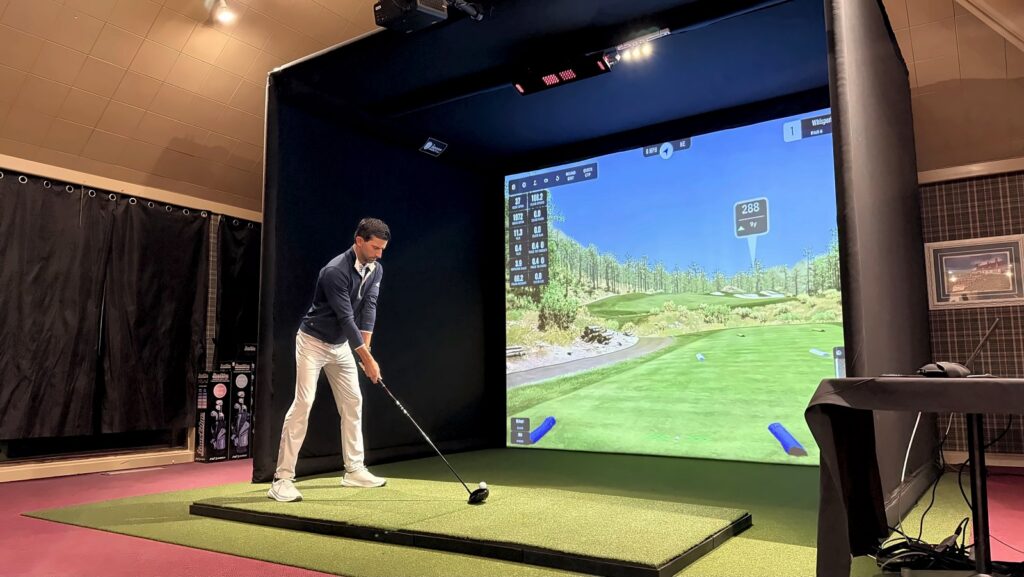
Jay built a SIGPRO Commercial enclosure at Tyrone Hills in Michigan in 2024, in a room the club had used for storage. It is now the home of the Darren Husse Golf Academy, where PGA professional Darren Husse teaches on it.
- Free-standing on purpose: a 1960s room with a tall vaulted ceiling and glass walls. The 2 in frame carries the Uneekor EYE XO and the projector, so it went up without making the room a construction project.
- Size and build: about 10 ft deep, almost 14 ft wide and 10 ft tall, with a 12 ft 6 in x 9 ft 8 in picture. Two people and a few ladders, three made it easy, about four hours.
- Safety: the screen wraps under a padded cable at the floor, so no ball gets under it, and padding covers the frame. Driver shots at about 164 mph stopped 2 ft 6 in to 3 ft off the screen. Jay's point for any business: balls that fly back can injure someone, and that is a liability.
- Room to swing: at about 14 ft wide a club clears with no trouble. Darren's view: students who worry about hitting the enclosure or the ceiling stop making their real swing.
- Turf and light: a Super Softy mat with a replaceable strip for the volume, and a blackout screen against the daylight, and a 4,000 lumen laser projector that holds up with the room lights on.
- Year-round lessons: before the simulator, teaching in Michigan stopped about November. Darren prefers winter for his most aggressive swing changes.
Jay also installed a Carl's Place PRO at Warwick Hills Golf and Country Club. The golf simulator enclosure guide sets every enclosure GSV has built side by side.
Step 6: Build out the space
- Lighting: keep light off the screen; avoid direct overhead lights at the screen end, put lighting on its own circuits and test dimming with the projectors on.
- Flooring: turf that takes heavy foot traffic, with padding or rubber underneath. The golf simulator flooring guide covers the options.
- Sound: ball strikes carry between bays and to neighbors. Treat the floor first, then add absorbing panels, seal doors and walls, and treat the ceiling if there is space above. One soundproofing maker measured an average of 10 dB less with a 1/2 in mat under a golf mat in its own test.
- Seating and a safety line: a standing-height bar or counter behind the hitting area gives watchers a place to stand and keeps them out of the swing.
- Power and network: have an electrician confirm the circuits and surge protection, with outlets at the ceiling for overhead units; wire each bay, and keep the simulators, payments and guest WiFi on separate networks.
- Mounts: fix ceiling units and projectors to the structure, not to ceiling tiles or light framing.
- Balls: clean, unscuffed white balls protect the screens. Foresight notes range balls spin and launch differently and wear out, and recommends the same premium ball model when comparing numbers.

Step 7: Booking, leagues, insurance and the liquor license
- Booking and payments: Trackman's portal handles bookings, payments and bay analytics; Foresight offers Foresight One per bay and named Whoosh, a third-party system, its preferred booking partner; Uneekor works with Alba. Other platforms built for simulator venues include ProAgenda, Teebly and Sports Carnival.
- Leagues: leagues fill quiet nights. Trackman Leagues runs season-long competitions for sim centers, and E6 CONNECT's Commercial Suite has league management. The Simulator Golf Tour, run on GSPro, is an online membership for individuals, so check GSPro's terms before running paid GSPro leagues.
- Insurance: specialty programs for simulator businesses cover general liability, liquor liability, the equipment itself, business interruption, equipment breakdown and customer data. Flying clubs and alcohol are the risks insurers name.
- Liquor license: set by your state and local authority. The federal TTB sends businesses to their state alcohol control board, so start early.
Step 8: Market it
- Social media: short videos of the bays in use, customer shots and offers on Instagram, Facebook and TikTok.
- Leagues and tournaments: regulars who come back every week.
- Group packages: corporate events, birthday parties and off-peak bundles.
- Local partners: golf shops, hotels and sports bars to cross-promote with.
- Be found: list the business where golfers search, including booking marketplaces.
Adding a simulator to a bar, hotel or entertainment center
- Bars and restaurants: a reason to come in and stay longer, all year in any weather, and a draw for groups. The NGF found simulator customers spend about $40 on food and drink per visit at the facilities it surveyed.
- Hotels: an amenity that sets the hotel apart, for business travelers after meetings and for company outings and local events.
- Family entertainment centers: most simulator software has games beyond golf, so children and non-golfers can play, and it adds a revenue line next to the other activities.
Safety and liability. A commercial bay puts clubs and balls near people who may never have swung in a simulator. Mark where watchers stand, set the tee so a miss stays in the enclosure, and talk to your insurer about the bay layout before opening. Golf Simulator Videos and its affiliates take no responsibility for your safety, or for any injury or damage, when you or your customers swing indoors.
GSV codes for a commercial build
GSV250 takes $250 off Shop Indoor Golf's enclosures and simulator packages (GSV5OFF takes more on a first order over $5,000), and the Carl's Place code comes by email from the form below. Every GSV code is on the golf simulator discount codes page.
5% off at Carl's Place
Type your email address. The code and the link are sent to you right away.
GSV emails you the code and the link, and may follow up once about your build.
Free consultation with GSV's partner builders
Planning a commercial bay or a whole venue? Jay works with official partners: master builders he hand-picked, who get on a call quickly and make sure you have the right fit before you buy anything. They offer package deals on the whole build, DIY packages to put together yourself, full installation, and more. The consultation is free.
Get a free commercial consultation
Golf simulator business questions
How much does it cost to open a golf simulator business?
It depends on the model. Golf courses with simulators surveyed by the NGF reported an average investment of $45,000 per bay, and Shop Indoor Golf puts commercial bay equipment at $15,000 to $30,000 before build-out. A standalone venue adds rent, build-out, staff and licensing; X-Golf puts a franchise location at $993,000 to over $1.9 million in total.
Are golf simulator businesses profitable?
Many are. In the NGF's survey of golf courses, 80% of those with simulators reported reaching profitability within their first year, at an average of $55 per session plus about $40 in food and drink. Those are golf courses, not standalone venues, which carry their own rent.
Can you use GSPro in a commercial golf simulator business?
Not under its published terms, which license GSPro for personal, non-commercial use by one person at a time, and GSPro publishes no commercial license. Get GSPro's written approval before charging customers to play it.
How much is a Trackman commercial license?
Trackman lists a Commercial License for the iO at $1,100 a year, for golf centers, clubs and entertainment venues. Its iO commercial bundle launched at $21,495 in 2023 and includes Trackman's business tools.
How big should a commercial golf simulator bay be?
About 15 ft wide, 18 to 20 ft deep and 10 ft or more high, so left- and right-handed golfers can share it. Uneekor's commercial minimum is 15 ft wide, 16 ft deep and 10 ft high, and Trackman plans for 15 ft wide, 10 ft high and 18 ft deep per bay.
What enclosure is best for a commercial golf simulator?
One built for commercial use, such as the SIGPRO Commercial Enclosure or the Carl's Place PRO. Shop Indoor Golf does not recommend its Preferred screen for commercial settings. GSV250 takes $250 off Shop Indoor Golf's enclosures, and the Carl's Place code comes by email.
What do golf simulator venues charge per hour?
The NGF found an average of $55 per session of just over an hour at golf facilities with simulators. Local prices vary with the market, the time of day and whether the bay is rented by the hour or per person.
What insurance does a golf simulator business need?
Specialty programs for simulator businesses cover general liability, liquor liability, the equipment, business interruption, equipment breakdown and customer data. Ask an insurer about your bay layout before opening.
Do you need a liquor license for a golf simulator bar?
Only to serve alcohol, and it comes from your state and local authority. The federal TTB sends businesses to their state alcohol control board, so start early.
More from GSV
Build the rest of your sim
- Enclosure and screen$250 off at Shop Indoor GolfShop
- Carl's Place enclosure5% off, code sent by emailShopGet the code
- Hitting mat$20 off at Shop Indoor Golf. GSV5OFF is more on a first order over $400Shop
- Projector5% off at Shop Indoor Golf. First-time buyersShop
- Simulator computerSurfThing: $100 off applied automatically, no codeShop
- TouchscreenGSV code for TouchscreenGuruShop
- Complete package$250 off at Shop Indoor Golf. GSV5OFF is more on a first order over $5,000Shop
GSV earns a small commission on these links, at no extra cost to you. Shop Indoor Golf takes one code per order.