
A golf simulator is loud in three places: the ball hitting the screen, the club and the ball hitting the floor, and anything the ball reaches behind the screen. Most of that noise can be cut without tearing out walls, and the cheapest fixes come first: the screen, how it hangs, the gap behind it and what is under the turf. Stopping sound from reaching a bedroom or a neighbor is a different job, and it takes mass and sealing rather than foam. Jay Lasco, host of Golf Simulator Videos, has hit into single and three-layer screens in garages, a basement studio and a golf club, and the quietest screens he has built with are below. Here is where the noise comes from, what quiets each part, what the makers say and what they do not, and what to do first in a garage, a basement under bedrooms or an upstairs room.
Codes first: GSV5OFF takes 5% off a first order at Shop Indoor Golf, for a screen, wall padding or curtains. GSV250 takes $250 off a SIG enclosure or SIGPRO flooring, and on a first order over $5,000 GSV5OFF takes more. Carl's Place sends GSV's code by email.
Quieter screens and flooring
- SIGPRO Premium impact screen5% off at Shop Indoor Golf with code GSV5OFF.First-time buyers only, one use. Not valid on a standalone Trackman, the Square Golf launch monitor or the ProTee VX.
- SIGPRO Premier gray impact screen5% off at Shop Indoor Golf with code GSV5OFF, first-time buyers.
- Carl's Place enclosures and screens5% off at Carl's Place. GSV emails you the code.
- SIGPRO Golf Simulator Flooring$250 off at Shop Indoor Golf with code GSV250.SIG8, SIG10 and SIG12 enclosures and studios, DIY and commercial enclosures, G-TRAK screens, SIGPRO flooring and complete simulator packages.
Buying through GSV's links and codes helps support the channel: GSV earns a small commission at no extra cost to you, and you still get every saving available.
- 3 layersThe screen build both makers call quieter
- 12 to 16 inFrom a hung screen to the wall, about 14 in at best
- 61.1 to 51.5 dBA golf mat alone, then over a 1/2 in rubber mat, in one soundproofing maker's test
On this page: the short answer, where the noise comes from, the screen, behind the screen, the floor, walls, ceiling and curtains, neighbors and other rooms, fans, what Jay found, what to do first, free consultation and questions.
The short answer
- Use a three-layer impact screen. The SIGPRO Premium and the Carl's Place Premium both have a cushioning middle layer, and both makers call them quieter than a single-layer screen.
- Hang it flat, not tight, with a gap behind it. A screen pulled tight cracks and springs the ball back. Loose zip ties or fewer bungees let it give, and 12 to 16 in of space keeps the ball off the wall.
- Put padding under the turf. Turf straight on concrete is hard and loud, and a rubber or foam layer under the mat cuts the thump that travels through the floor.
- Absorb the echo, then block the sound. Acoustic tiles and padding quiet the room itself. Keeping sound out of the next room takes mass and sealed gaps: drywall, seals and sweeps on the doors.
Where the noise comes from
- The ball on the screen: the crack or thud of every shot, and the loudest part in most rooms. The screen's layers and how it hangs decide which you get.
- The ball behind the screen: a screen hung close to a wall lets the ball reach it, and that hit is louder than the screen itself.
- The club and the ball on the floor: the strike on the mat and the ball dropping and rolling after the screen. On a slab or an upstairs floor it carries through the structure into other rooms.
- Echo: bare walls, a concrete floor and an open garage bounce every sound around the room.
- Fans: the projector and the PC run the whole session. They are quiet next to a shot, but they are the noise between shots.
No impact screen maker publishes a decibel figure for its screens, so there is no number to compare one screen with another. What the makers do publish is which build they call quieter.
The screen: three layers are quieter
A single-layer screen is one woven or knit sheet. A three-layer screen has two tight-knit faces with spacer yarns between them, and that middle layer cushions the ball. Shop Indoor Golf says its SIGPRO Premium's vertical spacers act as a cushion and dampen the noise of the ball hitting the screen. Carl's Place says its Premium reduces sound and minimizes bounce-back, and it gives noise dampening only to its Premium and High-Contrast Gray.
| Screen | Build and noise | List price |
|---|---|---|
| SIG Preferred | Single layer, about 0.03 in thick, louder | $295.99 to $709.99 by size |
| SIGPRO Premium | Three layers, white, about 0.14 in thick, quieter | $419.99 to $979.99 by size |
| SIGPRO Premier | The Premium's three layers in gray | $689.99 to $1,589.99 by size |
| Carl's Place Premium | Three layers, white, noise-damping center layer | From $439.95 |
| Carl's Place High-Contrast Gray | The Premium's three layers in gray | From $449.95 |
Shop Indoor Golf's and Carl's Place's list prices, read October 17 and 19, 2026. The SIGPRO Premium is the screen that comes in the SIG8, SIG10 and SIG12 enclosures. White or gray, every size and the full lineup are in the impact screen guide.
How it hangs matters as much as the material. Both makers say a screen pulled too tight bounces the ball back harder, and a tight screen is a louder one. Shop Indoor Golf suggests fewer bungees along the bottom, or leaving one off every few grommets, so the screen can flex. On Jay's newest build, a Carl's Place PRO, the screen hangs loosely on zip ties instead of ball bungees: it absorbs the ball, and a shot lands with a thud rather than a crack.
Behind the screen
- Leave 12 to 16 in to the wall, about 14 in at best. That is GSV's rule for a screen hung in the room: the screen can give, and the ball never reaches the wall. An enclosure's own frame sets the gap for you.
- Keep foam off the back of the screen. Foam, a mattress or a blanket pressed against the back stops the screen from giving and wears it fast.
- Hang something soft with a gap. A heavy moving blanket or archery netting hung behind the screen, not touching it, softens what gets through.
- Pad a hard wall behind it. Concrete block or a garage door behind the screen rings when a ball gets through. SIGPRO wall padding there, still with the gap, takes the hit.
Shop Indoor Golf's blackout screen is made to go close behind its SIGPRO screens, where it stops the projector's light coming through. The net vs impact screen guide covers the gap for nets too.
The floor
Carl's Place says concrete is hard and loud and makes the ball bounce unpredictably after it drops from the screen, and that turf with padding under it softens the sound of the ball dropping and rolling around the bay. The strike itself travels too: a mat on a bare slab or a plywood floor sends a thump through the building.
Second Skin Audio, a soundproofing maker, tested a 0.8 in golf mat with a 3/8 in foam backing on a plywood attic floor over 33 swings, with a sound meter app on a phone. The mat alone averaged 61.1 dB at its peaks. The same mat over a 1/2 in rubber mat averaged 51.5 dB, about 10 dB less. It is one maker's test of its own product, but it is the only published figure GSV found, and it shows how much the layer under the mat matters upstairs. Source: Second Skin Audio's golf mat test, updated August 25, 2025.
- SIGPRO golf simulator flooring: Shop Indoor Golf's floor for its enclosures, 2 in interlocking panels under putting turf, 2 3/8 in high, with the hitting strip let in. GSV250 takes $250 off it.
- Carl's Place floor tiles and turf: interlocking foam tiles 1 1/4 in thick with turf on top, and the HotShot mat. The code comes by email.
- Turf over a wood subfloor: the floor for a dedicated room or a basement slab.
Every layer, and how to set the mat level with the turf, is in the golf simulator flooring guide.
Walls, ceiling and curtains
Padding and tiles do two jobs: they protect the walls from stray shots, and the softer surfaces cut the echo inside the room. None of the golf sellers claims its padding blocks sound from leaving the room.
| Product | What it is | List price |
|---|---|---|
| SIGPRO wall padding | 3 1/16 in memory foam, vinyl covered, walls and ceiling | $109.99 (2 x 1 ft) to $149.99 (3 x 3 ft) a panel |
| SIG 1 in wall panels | Vinyl covered, glue, tape or Velcro | $54.99 (2 x 1 ft), $64.99 (2 x 2 ft) |
| Carl's Place acoustic tiles | 25 tiles, 2 x 2 ft, about 3/8 in thick, adhesive backed | $279.95 for 100 sq ft |
| SIG curtains | Blackout, 52 in wide, for 8, 9 or 10 ft ceilings | $299.98 to $359.98 |
| Carl's Place golf room curtain | Blackout or net, weighted, on a ceiling track | From $325 |
From Shop Indoor Golf's and Carl's Place's product pages, read October 19, 2026.
- SIGPRO wall padding is the one built to take a ball: Shop Indoor Golf says balls bounce right off it and it protects the walls. Velcro or adhesive is not included. Put it on the walls beside the screen and on the ceiling near it.
- Carl's Place acoustic tiles are the one sold for sound: Carl's Place says they absorb sound and improve the room's acoustics, and that they are not built to take direct hits, only glancing blows. They suit the side walls and the ceiling back from the screen.
- Curtains are sold for light and for slowing stray balls, not for sound. Carl's Place says to leave 12 in or more behind a curtain meant to catch balls.
SIGPRO wall padding at Shop Indoor Golf SIG curtains
5% off at Carl's Place
Type your email address. The code and the link are sent to you right away.
GSV emails you the code and the link, and may follow up once about your build.
Neighbors, bedrooms and apartments
Absorbing the sound inside the room and blocking it from the next room are different jobs. Foam and tiles cut echo, but they do little to stop sound passing through a wall, a ceiling or a gap under a door. Soundproofing sellers such as Soundproof Cow point to mass and sealing for that: another layer of drywall, mass-loaded vinyl and acoustic insulation in the walls, a dropped ceiling, and seals and sweeps on every door, with gaps filled with acoustic sealant.
- A room beside a bedroom: start with the screen, the gap and padding behind it, then seal the shared door. Hit a few shots at the hours you plan to play, into the screen you are thinking of, before you build it in.
- An upstairs room or an apartment: the floor comes first. The thump of the club and the ball travels down through the structure, so a rubber or foam layer under the mat and turf matters more than anything on the walls.
- A basement under bedrooms: the ceiling carries the sound up. Insulation between the joists and a dropped ceiling help, and the basement golf simulator guide covers the ceiling height that leaves.
- A garage: echo is often the bigger problem. A three-layer screen, padding on a hard back wall and turf over foam tiles quiet it, and the garage golf simulator guide covers the door and the room.
Soundproof Cow's guide: how to soundproof a golf simulator room. It gives no measured figures.
Projector and PC fans
Between shots, the fans are what you hear. Projector makers publish fan noise: BenQ lists 34 dB, and 29 dB in Eco mode, for its AK800ST and AK900ST golf projectors. Eco mode is quieter and dimmer. A PC in a closed cabinet, or in the next room with long cables, keeps its fans out of the room, and SurfThing designs its simulator PCs to run cool and quiet. See the projector guide and the golf simulator computer guide.
What Jay found
- Carl's Place Premium, white, 2022 and 2023: very quiet in a big, echoey garage, and a 162 mph drive came back only a short way.
- SIGPRO Premium in a SIG10, 2023: tight on every bungee with no sag, and still quiet with little bounce-back.
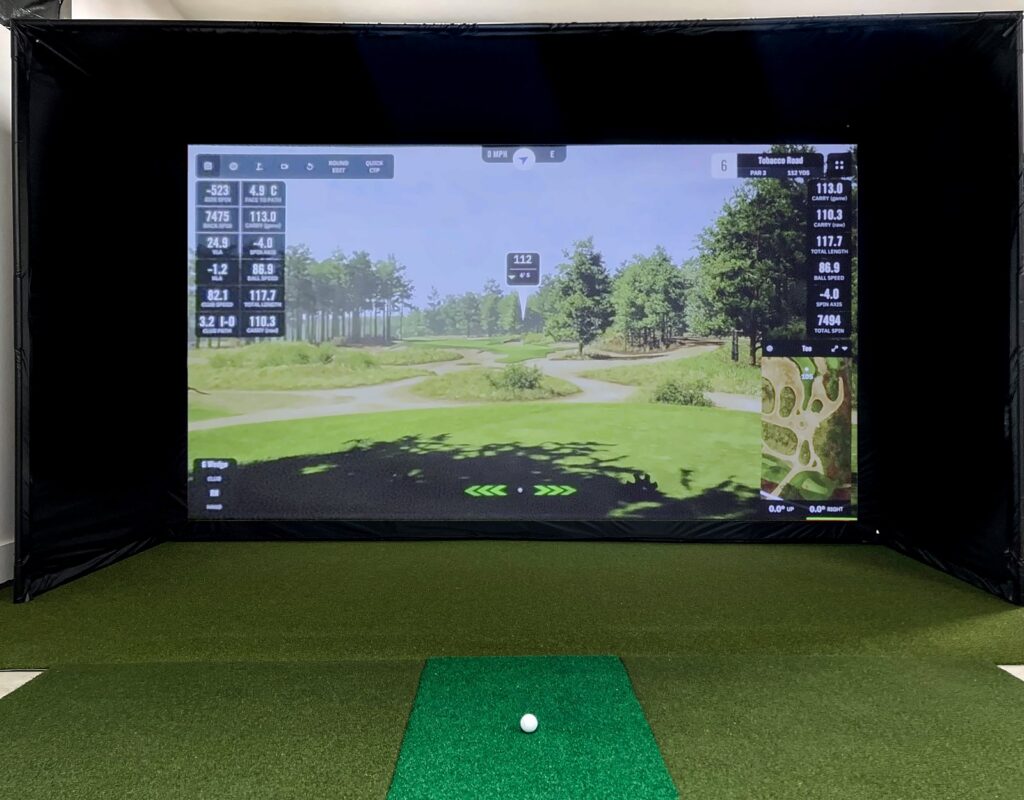
- Carl's Place High-Contrast Gray on the Carl's PRO, 2025: hung on loose zip ties, a thud rather than a crack, and a 166 mph drive did not come halfway back to the mat.
He has recommended a three-layer screen on every build since: quieter, softer on the ball and a smoother picture. Every enclosure he has built is in the enclosure guide.
What to do first
- The screen: a three-layer screen, hung flat but not tight.
- The gap: 12 to 16 in behind it, with a blanket or archery netting hung in the gap and nothing pressed on the screen.
- The floor: padding or foam tiles under the turf, and a rubber layer under the mat upstairs.
- The walls: padding on any hard surface the ball can reach, acoustic tiles for the echo.
- The building: seals and sweeps on the doors, then drywall and insulation if sound still reaches the next room.
Lay out the room, the screen and the gap behind it in the GSV Sim Builder.
Screens, flooring and enclosures
- SIGPRO Premium impact screen5% off at Shop Indoor Golf with code GSV5OFF.First-time buyers only, one use. Not valid on a standalone Trackman, the Square Golf launch monitor or the ProTee VX.
- SIGPRO Premier gray impact screen5% off at Shop Indoor Golf with code GSV5OFF, first-time buyers.
- Carl's Place enclosures and screens5% off at Carl's Place. GSV emails you the code.
- SIGPRO Golf Simulator Flooring$250 off at Shop Indoor Golf with code GSV250.SIG8, SIG10 and SIG12 enclosures and studios, DIY and commercial enclosures, G-TRAK screens, SIGPRO flooring and complete simulator packages.
- Golf simulator enclosures and screens$250 off at Shop Indoor Golf with code GSV250.
More on the room: bounce-back and protecting walls, ceiling and projector and impact screen care.
Free consultation with GSV's partner builders
Building next to a bedroom or over one? Jay works with official partners: master builders he hand-picked, who get on a call quickly and make sure the screen, the floor and the room work before you buy anything. They offer package deals on the whole build, DIY packages, full installation, and more. The consultation is free.
Golf simulator noise questions
How loud is a golf simulator?
No impact screen maker publishes a decibel figure, so there is no number for a screen. The loudest parts are the ball hitting the screen, the ball reaching a wall behind it, and the club and ball on a hard floor. In one soundproofing maker's test, a golf mat on a plywood floor averaged 61.1 dB at its peaks, and 51.5 dB with a 1/2 in rubber mat under it.
How do you make a golf impact screen quieter?
Use a three-layer screen such as the SIGPRO Premium or Carl's Place Premium, which both makers call quieter, and hang it flat but not tight, with fewer bungees along the bottom or loose zip ties. Leave 12 to 16 in to the wall behind it, and hang a blanket or archery netting in the gap without touching the screen.
Is a three-layer impact screen quieter?
Yes, by both makers. Shop Indoor Golf says the SIGPRO Premium's spacer yarns cushion the ball and dampen its noise, and Carl's Place says its Premium reduces sound and minimizes bounce-back. Jay recommends a three-layer screen on every build.
Should foam go behind a golf impact screen?
Not against it. Foam, a mattress or a blanket pressed on the back of the screen stops it from giving and wears it fast. Hang a heavy blanket or archery netting behind the screen with a gap, and put padding on a hard wall behind that.
Does wall padding soundproof a golf simulator room?
Padding and acoustic tiles cut the echo inside the room and protect the walls, but they do little to stop sound reaching the next room. That takes mass and sealing: drywall, insulation, and seals and sweeps on the doors.
Can you have a golf simulator in an apartment or an upstairs room?
The floor is the problem upstairs, since the thump of the club and the ball travels down through the structure. Put a rubber or foam layer under the mat and the turf, use a three-layer screen with a gap behind it, and hit a few shots at the hours you plan to play before building it in.
What is the quietest floor for a golf simulator?
Turf over padding or foam tiles. Carl's Place says bare concrete is hard and loud, and that padding under the turf softens the sound of the ball dropping and rolling. SIGPRO flooring and Carl's Place foam tiles with turf are both built for it.
Is there a discount code for impact screens and wall padding?
Yes. GSV5OFF takes 5% off a first order at Shop Indoor Golf, for screens, wall padding and curtains. GSV250 takes $250 off a SIG enclosure or SIGPRO flooring, and on a first order over $5,000 GSV5OFF takes more. Carl's Place sends GSV's code by email.
Build the rest of your sim
- Enclosure and screen$250 off at Shop Indoor GolfShop
- Carl's Place enclosure5% off, code sent by emailShopGet the code
- Hitting mat$20 off at Shop Indoor Golf. GSV5OFF is more on a first order over $400Shop
- Projector5% off at Shop Indoor Golf. First-time buyersShop
- Simulator computerSurfThing: $100 off applied automatically, no codeShop
- TouchscreenGSV code for TouchscreenGuruShop
- Complete package$250 off at Shop Indoor Golf. GSV5OFF is more on a first order over $5,000Shop
GSV earns a small commission on these links, at no extra cost to you. Shop Indoor Golf takes one code per order.